
Antibiotic (Antimicrobial) use in Canine Acute Diarrhoea in dogs (CAD)
Introduction
RUMA CA&E’s aim is to galvanise and support the veterinary profession to reduce antibiotic use for Canine Acute Diarrhoea (CAD) nationally by providing a set of resources that inform decision-making when veterinary teams are presented with a dog with acute diarrhoea. This activity is designed to help support the delivery of the national reduction targets by focusing on reducing the use of antibiotics (antimicrobials/antibacterials) in frequently encountered conditions where the prevailing evidence does not support antibiotic use in the majority of cases.

On this page
- Why aren’t antibiotics indicated for routine use in the treatment of CAD?
- Why using antibiotics can be harmful?
- Is it safe not to prescribe antibiotics (antimicrobials) when presented with a dog with CAD?
- Is there evidence and guidelines that support not using antibiotics (antimicrobials) for dogs with CAD?
- What changes can you make?
- What if a case doesn’t recover and I feel I have done the wrong thing?
- What other treatment options can be considered?
- What can I do if an owner expects or requests antibiotics?
- How can our practice play a role in tackling antimicrobial resistance (AMR)?
- How can I engage colleagues to ensure a consistent approach to CAD management?
- Where can I find out more?
- Feedback
Why aren’t antibiotics indicated for routine use in the treatment of CAD?
Dogs with acute diarrhoea, with or without blood, that are systemically well or that have mild or moderate systemic signs (Diarrhoea infographic) show minimal to no benefit from antibiotic use. Nearly all will resolve within 5-7 days regardless of whether antibiotics are used.
A recent VetCompass study found that prescription of antibiotics at first presentation of uncomplicated diarrhoea in dogs had no difference in clinical resolution of these cases. The study of 894 dogs shows that dogs with uncomplicated diarrhoea do not need antibiotics as part of their veterinary care plans. These findings will help veterinary surgeons care for their canine patients while avoiding unnecessary use of antibiotics, and ensure owners know what to expect when seeking veterinary advice.
In fact, antibiotics are more likely to cause negative consequences (intestinal dysbiosis, adverse effects for the individual animal, prolongation of diarrhoea and potentiation of AMR). Every time antibiotics are used, bacteria get a chance to develop resistance. That doesn’t mean they shouldn’t be used at all – it just means they should only be used where appropriate.
Why using antibiotics can be harmful?
Every time antibiotics are used, bacteria get a chance to develop resistance and this makes it harder to treat infections for that patient in the future. In addition, bacteria are shared between pets and their owners (and vice versa). Antimicrobial resistance (AMR) is projected to cause up to 39 million human deaths by 2050 if left unchecked and will make our jobs more difficult; there will be conditions we can no longer treat and surgeries we can no longer carry out.
In addition, antibiotics can have side effects such as gastrointestinal issues, including vomiting, diarrhoea, and loss of appetite. Furthermore, antibiotic use can disrupt the gut microbiota (dysbiosis), reducing microbial diversity and altering normal gut function; these changes may persist beyond the treatment period and can be associated with longer-term effects on gut health. This doesn’t mean that antibiotics shouldn’t be used at all – it just means they should only be used when absolutely necessary.
Is it safe not to prescribe antibiotics when presented with a dog with CAD?
Every animal should be carefully evaluated to guide decision making. For dogs with mild or moderate disease, antibiotics do not reduce mortality, prevent progression of disease or significantly shorten the disease course (Efficacy of antimicrobial and nutraceutical treatment for canine acute diarrhoea: A systematic review and meta-analysis for European Network for Optimization of Antimicrobial Therapy (ENOVAT) guidelines – PubMed). For a very small minority (~1%) of dogs that present with acute diarrhoea and severe disease (those suspected of developing sepsis), broad spectrum antibiotics are recommended.
Is there evidence and guidelines to support not using antibiotics (antimicrobials) when presented with a dog with CAD?
Yes. A recent, RVC/VetCompass study and the ENOVAT guidelines (informed by a systematic review of the veterinary literature) shows that antibiotics aren’t needed for CAD unless there are signs suggestive of sepsis. The research indicates metronidazole should not be a first-line treatment for acute, uncomplicated diarrhoea in dogs because it does not speed recovery, causes significant gut microbiome disruption, and promotes antimicrobial resistance. Please also watch this video to see the rationale and scientific basis for this recommendation VetCompass – Antimicrobial Stewardship Resources.
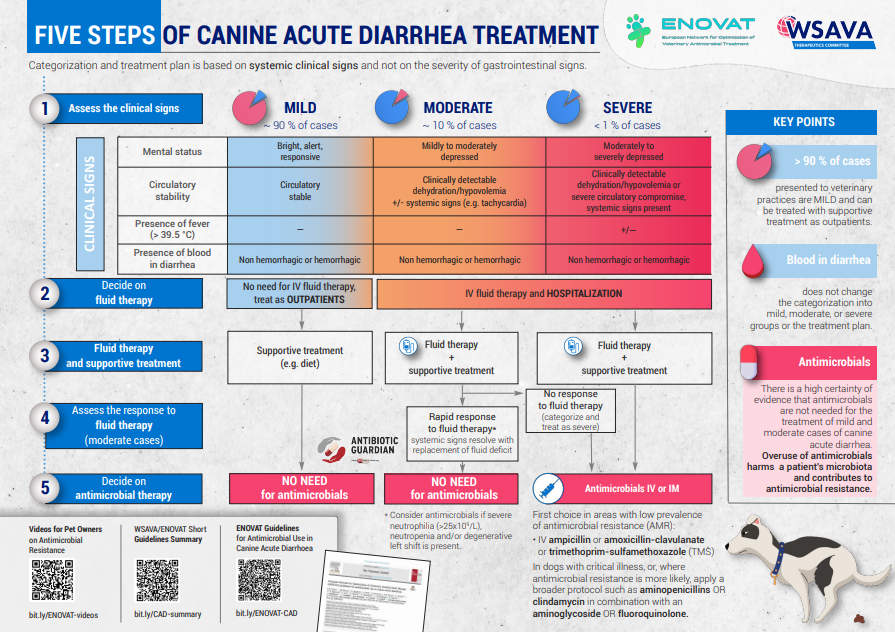
The above infographic shows the five steps of acute canine diarrhoea management. Based on the ENOVAT guidelines, the evidence suggests that in the 90% of CAD cases which are considered mild, antibiotics should not be used. Dogs with diarrhoea that are moderate cases (depressed, dehydrated and may have systemic signs), often require hospitalisation for supportive therapy (IV fluids). Even then, antibiotics should only be used unless the dog is not responding to supportive therapy or is showing signs that would place it in the severe category – such cases are likely very rare (~1% of all dogs with acute diarrhoea).
What changes can you make?
The change/s you make will depend on what your current prescribing practices are – it can be a journey that you and your practice goes on:
- If you are currently giving antibiotics to the mild category, consider reserving them for those that you are admitting only (moderate cases) in the first instance.
- If you are currently giving them to moderate cases when you admit, consider reserving them for the severe cases where there are the signs of systemic inflammatory response.
- If you are currently giving fluoroquinolones (a HP-CIA) or metronidazole to these acute cases, try using a different antibiotic first; then move on to trying not to give any at all. Metronidazole is the most commonly prescribed antibiotic for management of acute diarrhoea. However, a damaging impact on the microbiome has been documented (Pilla et al., Suchodolski et al) representing an important adverse effect and strong reason to avoid this antibiotic.
- If the presence of blood is a factor that influences your use of antibiotics, the guidelines state that this does not change the severity category and therefore should not lead to antibiotic use. Some owners may be aware of human medical advice where blood in stools can indicate some serious conditions – reassurance for clients may be necessary.
From where you are now, each step towards only giving antibiotics to those severe cases that really need them is a step forward in antimicrobial stewardship – you don’t need to move to only giving antibiotics to 1% of cases in one go – get there gradually.
What if a case doesn’t recover and I feel I have done the wrong thing?
Some cases – be that diarrhoea, heart cases, diabetic cases – will not progress as expected, but if you have followed these established and evidenced guidelines then you haven’t done anything wrong, and your actions are totally defendable (if it should ever come to that). It is always worth reflecting on these cases as a team to see what has been learnt and whether you would do things differently next time.
Most diarrhoea cases that do not resolve quickly will progress slowly allowing time to revisit and refine the treatment plan. Rapid deterioration suggests serious underlying disease prompting further diagnostic investigations and supportive treatments.
It may be prudent to have clinical guidelines or an approach to a case that looks like it is progressing towards being a chronic diarrhoea case (not the subject of this focus area).
One case that does not progress in the way expected does not mean that the guidelines are wrong and should not be followed in the future – but it is easy to focus on that one case.
Are there other treatment options that can be considered?
Nutritional support (gastrointestinal diets or bland food) is the cornerstone of management of dogs with acute diarrhoea and this is usually sufficient. However, there may be some dogs (particularly if the diarrhoea is not resolving as quickly as expected) where adjunctive, non-antibiotic therapy is considered. Evidence supporting the use of prebiotics or probiotics remains equivocal. However, these products are unlikely to cause any harm and may be viewed as options only (if the owner can afford them); they are not a necessity. Binding agents such as kaolin, pectin or montmorillonite, may also help improve stool consistency.
Additional measures (e.g. intravenous fluid therapy, anti-emetics, analgesics) should be considered on a case-by case-basis. The ENOVAT guidelines offer further information as to when these should be considered.
What if an owner expects or requests antibiotics?
The perception of client pressure/expectation is cited as one of the main reasons for veterinarians to prescribe antibiotics. However, pet owners will hear similar stewardship messages from other healthcare providers such as doctors, dentists and pharmacists. Maintaining a consistent message ensures that owners can be reassured that antibiotics are being withheld in the best interests of their pet and of wider society.
Some resources that may support this conversation with pet owners include the BSAVA/SAMSoc No antibiotic required prescription form. This form can be freely downloaded from the BSAVA Library (No antibiotic required ‘non prescription’ form | BSAVA Library). You can find a link to this resource and other useful resources further down this page.
Owners may also be primed to hear this message via this short educational animation from Antibiotic Resistance ENOVAT. This film describes a clinical scenario (a dog with diarrhoea) and presents an explanation as to why antibiotics are not indicated. After watching this film, pet owners were shown to have increased awareness of AMR and were less likely to request antibiotics from their vet.
How can our practice play a role in addressing antimicrobial resistance (AMR)?
Overuse or inappropriate use of antibiotics can increase AMR. It is vital that the companion animal sector does all it can to protect the efficacy of these important medicines by only using the right antibiotic at the right time, and for the right duration (reduce, refine, replace) in order to protect the wellbeing of people, pets and the planet.
Every time antibiotics are used, bacteria get a chance to develop resistance and this makes it harder to treat infections for that patient in the future. In addition, bacteria are shared between pets and their owners (and vice versa). Antimicrobial resistance (AMR) is projected to cause up to 39 million human deaths by 2050 if left unchecked and will make our jobs more difficult; there will be conditions we can no longer treat and surgeries we can no longer carry out.
Where can I find out more?
Below are some useful resources and links to help support your practice to assess and review its approach to CAD:
Studies/research/reports
- VetCompass study. This infographic illustrates the findings: Diarrhoea infographic
- Epidemiology and clinical management of acute diarrhoea in dogs under primary veterinary care in the UK | PLOS One
- ENOVAT guidelines
- Associated systematic review: Efficacy of antimicrobial and nutraceutical treatment for canine acute diarrhoea: A systematic review and meta-analysis for European Network for Optimization of Antimicrobial Therapy (ENOVAT) guidelines – PubMed. Scahill K, Jessen LR, Prior C, Singleton D, Foroutan F, Ferran AA, Arenas C, Bjørnvad CR, Lavy E, Allerton F, Weese JS, Allenspach K, Guardabassi L, Unterer S, Bodnárová T, Windahl U, Brennan ML, Werner M. Efficacy of antimicrobial and nutraceutical treatment for canine acute diarrhoea: A systematic review and meta-analysis for European Network for Optimization of Antimicrobial Therapy (ENOVAT) guidelines. Vet J. 2024 Feb;303:106054. doi: 10.1016/j.tvjl.2023.106054. Epub 2023 Dec 2. PMID: 38049062.
- Understanding the rationale for metronidazole use in dogs and cats Understanding the rationale for metronidazole use in dogs and cats – Ng – 2025 – Journal of Small Animal Practice – Wiley Online Library
- What drives antimicrobial prescribing for companion animals? What drives antimicrobial prescribing for companion animals? A mixed-methods study of UK veterinary clinics – ScienceDirect
- Project to identify and promote effective and practical antimicrobial stewardship interventions for widespread adoption in veterinary practice – funded by the Petplan Charitable Trust – Improved Stewardship to Protect Veterinary Antimicrobial Usage in UK Cats and Dogs (In Progress) – Projects – Research Projects and Opportunities – VetCompass – Royal Veterinary College, RVC
- VetPartners’ 2025 Antibiotics Stewardship Report – data in this report shows the use of antibiotics across all species in its UK practices has more than halved since 2021. VetPartners Antibiotic Stewardship Report 2025 | VetPartners Group
How can I engage my practice team? Resources for practice teams to use to support discussions:
- Team discussion document – this downloadable resource is designed to support veterinary practice team discussions about CAD and explore ways to reduce unnecessary antibiotic use as a practice. This document provides practical advice on starting team discussions and agreeing a plan of action to assess and reduce antibiotic use: CAD team discussion document
- Animation on CAD – this helpful animation created by The Royal Veterinary College (RVC) and VetCompass helps illustrate the opportunity that exists to reduce the use of antibiotics (antimicrobials) in the treatment of CAD. This is ideal to play at team meetings – VetCompass – Antimicrobial Stewardship Resources.
- RCVS Knowledge VetTeamAMR learning resource includes a 13 minute webinar by Dr Jan Suchodolski, Professor and Associate Director for Research and Head of Microbiome Sciences from the University of Texas, which discusses the responsible use of antibiotics in companion animals with acute diarrhoea – https://learn.rcvsknowledge.org/course/section.php?id=1095
- Supporting discussions around behaviour change: Agreeing a unified practice approach and understanding what the barriers to making changes might be is important. This might be a useful point of discussion at your team meetings: The COM-B Model for Behavior Change – The Decision Lab
- BSAVA and SAMSoc have worked together to provide information that is intended to support practices in discussing and drawing up practice guidelines on responsible antibacterial use PROTECT ME – Antibacterial Use in Veterinary Practice | BSAVA
- Antibiotic Guardian training – Companion animal and equine teams can access a free CPD course on Learn to become an antibiotic guardian, providing teams with knowledge, resources and tools to make positive changes in their antimicrobial prescribing. Antibiotic Guardians – RCVS Knowledge
- RCVS Knowledge Awards: These annual awards celebrate veterinary team achievements that contribute to advancing the quality of veterinary care and include a category on antimicrobial stewardship showcasing practical examples where teams are improving responsible antimicrobial prescribing using recognised quality improvement methods: Antimicrobial Stewardship – RCVS Knowledge
- Indications for antimicrobials in acute diarrhoea diagram: With thanks from RUMA CA&E to Inspiring Vet Care for allowing us to replicate their diagram for use in our toolkit.
Resources that practice teams can use to give or signpost owners to and/or display in the practice consulting and waiting rooms:
- This downloadable form from BSAVA can be printed off and given to clients where no antibiotic is required – No antibiotic required ‘non prescription’ form | BSAVA Library. It also provides a space for aftercare guidance and what owners should do if their pet’s condition changes.
- Antibiotic Resistance ENOVAT – a short animation for owners to highlight why antibiotics aren’t being prescribed
- General AMR posters for consult rooms and waiting rooms – Poster 1 / Poster 2 / Poster 3 / Poster 4 / Poster 5
- Dog Diarrhoea – PDSA
Auditing your activity:
- RCVS Knowledge Antimicrobial Audit Reporting Template: this free audit tool helps teams gather data to make the right, evidence-based decisions for their patients. Clients can be invited to report on treatment outcomes, allowing teams to see how antimicrobial prescriptions can be improved for specific clinical presentations. Access the template here.
Feedback
- If you have any feedback on the content of this page or have any suggestions for additional guidance and resources, please email rumacae@gmail.com